Blog August 27, 2026
The one-hour-a-week marketing plan for solo developers
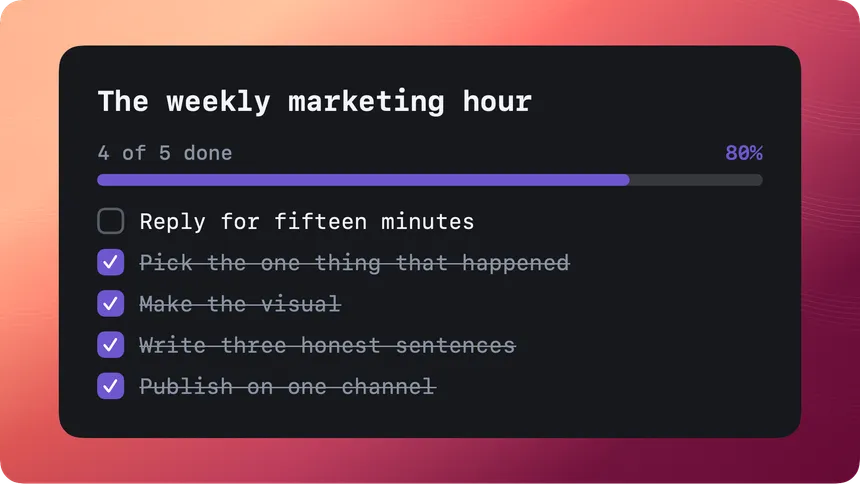
Every marketing guide I read as a builder assumed I had a marketing team, or at least a marketing afternoon. “Spend twenty percent of your time on distribution.” Twenty percent of my time was already spoken for by the bug tracker. What I actually had, honestly, was about an hour a week. So that became the plan.
It turns out an hour is enough. Not to go viral, not to run five channels, but to do the one thing that compounds: show up every week with something worth looking at. Here is the exact plan, minute by minute, and the rotation that means you never sit down wondering what to post.
Why one hour works
The reason most solo marketing dies is not lack of time. It is that every session starts from zero: what do I post, where, what should it look like? Those three open questions cost more energy than the posting itself, so the habit loses to the backlog by week three. I wrote about that trap in Building is fun. Marketing is hard.
A fixed hour removes the questions. Same slot every week, same steps in the same order, and a rotation that decides the topic for you. Constraint is the whole trick. You are not trying to do marketing well, you are trying to make it so cheap that skipping it feels sillier than doing it.
Put it in your calendar like a standup. Mine is Friday before lunch, because Friday is when the week’s work is visible and I still remember what happened.
The hour, minute by minute
Minutes 0 to 10: pick the thing. Look back at your week. One shipped feature, one number that moved, one bug that taught you something, one kind message. You need exactly one. The rotation below tells you which kind to look for, so this is a scan, not a brainstorm.
Minutes 10 to 25: make the visual. A post with a visual stops the scroll; a wall of text does not. This is the step that used to eat the whole hour for me, and it is the one to make cheap at all costs. Decide once what your posts look like, then reuse that look. More on this below.
Minutes 25 to 40: write the post. Three to six sentences. Say what happened, what it means, and one honest detail. No hooks, no “thread below”. Write it the way you would tell a friend who also builds things.
Minutes 40 to 45: publish. One channel. The one where your people actually are, which for most developers is X or LinkedIn. Resist the urge to cross-post everywhere; five channels at one hour a week means five audiences that each see a ghost town.
Minutes 45 to 60: reply. Answer comments on last week’s post, reply to two or three people in your niche, thank anyone who shared your work. This is the part everyone skips and it is quietly the highest-leverage fifteen minutes of the hour. Distribution is other people, and other people remember who showed up in their replies.
The four-week rotation
So you never face a blank slot, give each week of the month a fixed format:
- Week 1: your numbers. Users, downloads, revenue, whatever you track. Small is fine; honest is the point.
- Week 2: what you shipped. The release, however minor. Momentum is the message.
- Week 3: a lesson or a look behind the scenes. The bug, the refactor, the decision you sweated over.
- Week 4: a win or a voice. A milestone, or a kind word from a user, shared with permission.
That is the whole editorial calendar. It maps directly onto the formats I broke down in 8 things to post as a developer, and after a full month you have covered the spread: proof, momentum, process, people. Then it repeats, and nobody notices the repetition, because the content is new even when the shape is not.
What you deliberately skip
An hour only works if you protect it from everything that is not the hour. So, explicitly out of scope: starting a newsletter, learning a new platform, redesigning your landing page, watching your analytics refresh, and chasing whatever format is hot this month. Those are all real things you might do someday. They are not this hour.
The kill test is simple: does this put a post in front of my people this week? If not, it goes on a list for later, and later can be never. When you do have a bigger block free, spend it on the channels that compound, which I covered in How to promote your app without a marketing budget. But the weekly hour stays sacred and stays small.
Making minutes 10 to 25 nearly free
The visual step is where the hour is won or lost, so it deserves its own fix: make the design decision once, then never again. Lock in one look, one set of colors and type, and turn it into templates for the things you post repeatedly, your numbers, your release notes, your milestones.
This is exactly what I built Monocards for. The rotation above maps to ready-made cards: week 1 is a stats card, week 2 release notes, week 4 a milestone or a quote. You fill in the content, the template carries the look, and the visual step drops to two minutes. If you work with an agent, it goes further: it reads your week and fills in the card for you, through a local MCP server on your Mac. But with or without the app, the principle is what matters. If making the visual takes more than five minutes, you will skip it, and if you skip the visual, the post loses most of its reach.
What to expect, honestly
Weeks 1 through 4: silence. It feels like posting into a void, and everyone quits here. Weeks 5 through 12: small signs of life, a reply, a follow, someone mentioning your app back to you. After three months: the compounding starts, people recognize the look of your cards before they read your name, and the graph you were shy about at 40 visitors becomes the one you are glad you posted at 400.
Fifty-two hours a year. That is the entire cost. It is less time than you spent picking your database, and it is the difference between building in a vacuum and building in front of the people who will eventually pay for it.
Put the hour in the calendar. This Friday counts.