Blog August 20, 2026
How to promote your app without a marketing budget
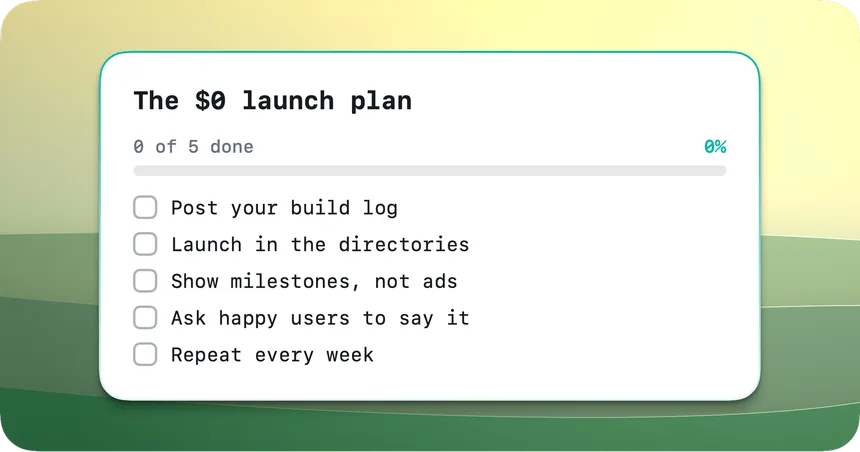
The short answer: you do not need a budget, you need a cadence. Ads are how companies with money buy attention. Builders without money earn it, by showing their work in public, in places where their users already are, week after week. That costs time instead of money, and much less time than you think.
Here is the plan I follow myself, in the order I would do it again.
Start with the channels you already have
Before you think about new audiences, use the ones sitting in front of you.
Your build log. Post what you are building while you build it, on X, LinkedIn, or wherever your users hang out. This is the highest-return free channel that exists, because it compounds: every post makes the next launch land on more people. You do not need an audience to start; you need to start to get an audience.
Communities you already read. The subreddits, Discords and forums of your niche. The rule everywhere is the same: be a member first and a founder second. Answer questions, share what you learned, and mention your app when it genuinely answers someone’s problem. One helpful comment in the right thread outperforms a hundred cold posts.
Your own users, even the first ten. Every early user knows other people like themselves. Ask them what to improve, and they will feel like part of the project. People share what they feel part of.
Launch more than once
Most builders launch once, on one channel, and call it done. A launch is not an event, it is a checklist you keep reusing.
The directories. Product Hunt is the famous one, but there are dozens of smaller ones: alternative-to sites, niche catalogs, “made with” lists, newsletter roundups. Each listing is a small stream of visitors and a backlink. Submit everywhere that fits, one per evening.
Every feature is a launch. Shipped something meaningful? That is a launch. New template, new integration, big fix: each one is a reason to show up in the feed again. My release notes get posted as a card every time, and they quietly outperform almost everything else I make.
Repurpose the same news. One update can be an X post, a LinkedIn post, a community comment and a changelog entry. That is not spam, that is respecting that different people live in different places.
Show, don’t announce
Here is where most zero-budget marketing dies: the post itself. A wall of text saying “v2.1 is out” gets scrolled past. The feed rewards things worth looking at.
So show the thing. A screenshot in a device frame instead of “new design”. A chart instead of “we grew this month”. The milestone as a card instead of a sentence. Release notes laid out like they matter. In my own feed, the posts with a visual reliably beat the text-only ones, and it is not close.
The catch is that making visuals is exactly the part builders postpone, because every one of them means design work. I wrote about that trap, and how to escape it by making the design decision once, in Building is fun. Marketing is hard. The short version: lock in one look, turn it into templates, and posting a visual becomes filling in content. That is the whole reason Monocards exists: eighteen card formats, from code snippets as images to charts from your numbers, that come out on-brand every time.
Turn your users into the marketing
Nothing you say about your app is as convincing as what someone else says about it.
Ask for the review at the right moment: right after someone tells you it helped them. Not in a popup on day one. Then reuse what they said, with permission, as a quote card in your feed and a review on your site. One honest sentence from a real user is stronger social proof than any feature list.
And make sharing easy. If your app produces something visible, let the output be beautiful enough that users want to post it. Every shared screenshot is marketing you did not do.
A weekly cadence that costs nothing
Everything above collapses into a routine that fits next to building:
- Monday. One numbers card: users, downloads, revenue, whatever you track. Honest numbers, small ones included.
- Wednesday. One helpful thing: a lesson, a snippet, an answer in a community.
- Friday. Ship notes: what went out this week, as a visual.
- Any day something lands. Milestone hit, nice review received: post it the same day.
That is four posts a week, none of which need creativity on demand, all of which come from work you already did. Give it eight weeks; the first two feel like talking to a wall, and around week six the wall starts talking back.
When paying does make sense
Honesty requires this section: ads are not evil, they are just the wrong first move. Paid promotion multiplies what already works. If nobody clicks your free posts, ads will only make the silence more expensive. Once a channel converts organically, then money can pour fuel on it.
Until then, the budget you actually need is an hour a day and the willingness to show your work before it feels ready. That part is free, and it is still the part most builders skip.