Blog August 28, 2026
Why I dropped my free tier
Yesterday I shipped an update that removed the free tier from Monocards. No more free card types, no more look-around mode. The download is still free, but the app now opens on a short intro and asks for a license before it does anything at all.
Two weeks ago I would have told you that was suicide for a brand new app. Here is what changed my mind.
The free tier felt safe
When I launched, the plan was textbook. Six of the eighteen card types were free to use, forever. The rest sat behind a one-time license. Free users would try the app, love it, hit the edge of the free set, and pay.
I liked this plan because it felt generous, and because it protected me from a scary question. If the app is partly free, nobody can be angry about the price. Rejection gets softer. Someone who does not pay is not saying no, they are just “still on the free tier”. You can live on that ambiguity for a long time.
I have shipped software for twenty years and I still fell for it. A free tier is not always generosity. Sometimes it is a way to avoid finding out what your work is worth.
What the numbers actually said
Monocards has been public for about two weeks. In that time, roughly 250 people visited the site. About 90 of them downloaded the app.
Seven ever opened it. And I am at least one of the seven.
Sit with that for a second, because I had to. The story I was telling myself was that a crowd of free users was out there evaluating the app, working their way toward the paid set. The story the numbers told was different: the leak in my funnel was not between trying and paying. It was between downloading and opening. The free tier was standing at a door almost nobody walked through.
That is the thing about a freemium plan at indie scale. It is a volume strategy. It works when thousands of people flow through and a few percent convert. With ninety downloads, “a few percent” is zero, and the free tier converts nothing because there is nothing to convert. It just sits there, making the pricing page longer.
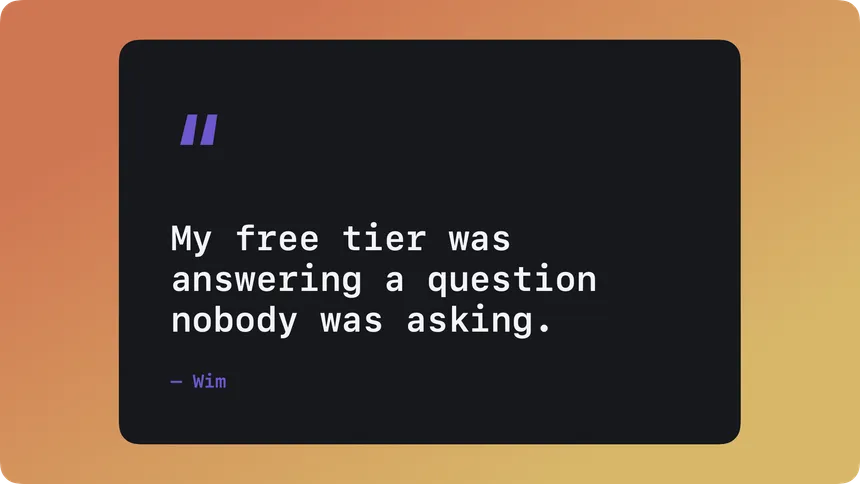
Free was answering a question nobody was asking
The question my free tier answered was “what if people want to try it first?”
Nobody was asking it. The people who downloaded and never opened the app did not need a softer price. The handful who did open it went straight to the edges of the free set anyway. And the people who mailed me questions asked about the license, the Macs it covers, the updates. Not one person asked for more free.
Meanwhile the free tier was quietly costing me things I did not put on any spreadsheet. Every feature needed two versions, a real one and a locked one with a little crown on it. Every screen needed an upsell state. The site needed careful sentences about what was free and what was not, and those sentences had to stay in sync with the app on every release. I was maintaining two products: the one people would pay for, and a worse one whose whole job was to advertise the first.
When I finally ripped it out this week, the change was mostly deletions. That told me something too.
What replaced it
The model now is one sentence: the download is free, the app needs a license to run, and there is a 14-day money-back guarantee.
That guarantee is doing the job the free tier pretended to do, and doing it better. A trial says “see if you can find the value before we talk”. A money-back guarantee says “use the whole thing, on your own files, and if it is not for you, one mail gets your money back”. The risk moves to my side of the table, which is where it belongs, because I am the one claiming the app is worth $29.
The other replacement is honesty in the copy. The download button on the site now says, right under it, that the app needs a license. I would rather lose a visitor at the button than have them discover a paywall the site never mentioned. Trust is the only marketing channel I fully control, a point I keep coming back to since Building is fun. Marketing is hard.
What I would tell you to check first
I am not going to tell you to drop your free tier. I do not know your product, and there are apps where free is the entire engine. But before you copy the freemium playbook, look at three numbers I ignored for two weeks.
Where the leak actually is. Pull up your funnel and find the biggest drop. Mine was download to first open, and no pricing model fixes that. If yours is trial to paid, free might genuinely be your problem or your answer. Guessing is the only wrong option.
What free costs you to maintain. Count the locked states, the gated screens, the “upgrade” copy, the support mails about what is included. If the free tier were a feature, would you build it today?
Whether a guarantee can do the same job. If your product shows its value inside a week, a refund window gives people the same safety as a trial without splitting your app in two.
And whatever you decide, decide it out loud. I posted the change, the reasons, and these numbers the same week I shipped it. The pivot itself became something to share, which at my size is worth almost as much as the revenue. That habit of turning the work into the marketing is the whole system behind my one hour a week plan, and a pricing change is one of the most honest things you will ever get to post.
Too early for a victory lap
I shipped this yesterday. I do not have a conversion story for you, and I will not invent one. Maybe the hard paywall filters out the noise and the seven openers become seven buyers a month. Maybe it just makes the silence cleaner. I will publish the numbers either way, because that was the deal when I started writing here.
What I do have is a simpler product, a price I can say out loud, and a funnel where every step means something. Ninety people downloading an app they never open taught me nothing. The next ninety will teach me everything.
If the free tier on your roadmap is there because it feels safe, that is the reason to look at it twice. Safe is what mine was. It just was not safe for the app.