Blog August 21, 2026
How to build a personal brand as a developer
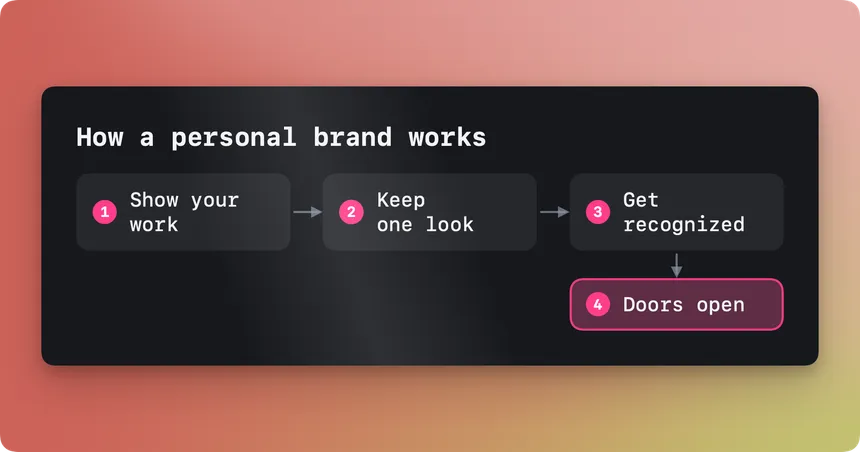
The short answer: a personal brand is not a logo, a color scheme or a bio that calls you a ninja. It is what people think of when your name comes up, multiplied by how many people think of you at all. You build it the same way you build software: small consistent commits, in public, over a long time.
Most developers flinch at the term, and I get it. It smells like self-promotion, and self-promotion smells like the opposite of letting the work speak. So let me start with the uncomfortable part.
Your code does not speak for itself
We love the idea that good work gets discovered. It does not. Work gets discovered when someone sees it, and nobody is browsing your repositories at night looking for hidden talent.
Every developer already has a personal brand. If you never show anything, that brand is “no idea who that is”. The choice is not between having one and not having one. It is between shaping it and leaving it at zero.
And the payoff is bigger than followers. A visible track record is why one developer gets the conference invite, the inbound client, the job offer without an interview gauntlet, and an equally good developer does not. I ran an agency for ten years; when we hired or partnered, the person whose work we had already seen started three steps ahead. That is what a personal brand is for: it moves the proof of your competence ahead of the conversation.
Pick a lane, not a persona
Personal branding goes wrong when people invent a character. You do not need a persona. You need a lane: the topic where your name keeps showing up.
Make it the intersection of what you build and what you can talk about honestly. Shipping a Mac app? Your lane is building native software solo. Deep in data pipelines? That is the lane. The test is simple: can you post about this weekly for a year without faking interest? If yes, it is your lane. If no, narrow it until it is.
Narrow feels scary and works better. “Developer” is invisible. “The person building a solo Mac app in public and showing the numbers” is someone people can remember, follow and recommend.
Show the work, not the resume
Nobody follows a list of achievements. People follow a story that is still happening. The way to tell that story is to show what you are doing while you do it, in small recognizable formats: what you shipped, what it changed, what you learned, what went wrong, what you just hit.
I broke down the six formats that successful builders rotate through in Building is fun. Marketing is hard., so I will not repeat the list here. The principle matters more than the list: share the process, not the polish. The post about the bug that ate your Saturday will outperform the feature announcement, because process is relatable and announcements are ads.
And show it visually. A feed is a wall of text; the posts people stop at are the ones with something to look at. A chart of your growth, your release notes as a card, the milestone made visible. That is what gets you seen at all.
Consistency is the brand
Here is the mechanism most guides skip: recognition does not come from any single post. It comes from repetition in the same shape.
That means two kinds of consistency. Rhythm: showing up on a schedule, even a modest one, beats bursts of activity followed by silence. And appearance: when everything you post shares one look, the same colors and type and layout, people recognize your work in the feed before they read your name. Your style literally becomes your logo.
This is where most developers quietly give up, because keeping a consistent look means design work on every single post. My fix is to make the design decision exactly once: lock in a look, save it as templates, and let every future visual come out of those. I built Monocards for precisely this, and if you use an agent, it can fill in your templates for you. But use anything you like; the principle is what counts. Design once, then never let design be the reason you skipped a week.
Where to show up
Choose one primary channel where your audience lives (for most developers that is X or LinkedIn) and one community you genuinely participate in. That is enough. A personal brand does not require being everywhere; it requires being findable somewhere, repeatedly.
Then let everything point home: one place you own, your site or blog, where your best work is collected. Platforms rise and fall; your domain is yours. For the practical channel-by-channel plan, including launching in directories and reusing every update, see How to promote your app without a marketing budget; the same playbook builds a personal brand, because for a solo builder the product and the person are the same story.
The timeline nobody promises you
Expect nothing for two months. Genuinely nothing: single-digit likes, zero comments, the distinct feeling of posting into a void. This is the phase where almost everyone quits, which is exactly why it works for the people who do not.
Somewhere around month three, strangers start replying. Around month six, someone you have never met describes you to someone else, in your lane, roughly the way you would have described yourself. That moment is the brand. It does not feel like fame. It feels like doors opening slightly before you knock, and it compounds for years.
You already know how to do the hard part; you ship. The brand is just shipping where people can see it, in a shape they can remember.